


Jefferson County Public Library
About > About the Library > How the Library is Funded
How the Library is Funded
Jefferson County Public Library is a public institution, funded primarily by the community it serves. Here’s a look at how the Library is funded.
Where our funding comes from
Like most public libraries in Indiana, Jefferson County Public Library is funded primarily by local property taxes, with additional support from state and federal programs, grants, donations, and small fees.
Property taxes are by far the largest source of funding. In 2025, the Library's property tax levy was $1,669,669, at a rate of $0.1030 per $100 of net assessed value. This is the Library's operating money, the funding that keeps the doors open and the shelves full. It makes up the large majority of the Library's roughly $2 million in total annual revenue.
State and intergovernmental funds provide additional support, including distributions the State of Indiana shares with public libraries. The State of Indiana supports local libraries largely through shared resources rather than direct operating funds. Through the Indiana State Library, residents get free access to statewide research databases (INSPIRE). The Library also saves revenue by participating in consortia borrowing systems, such as Evergreen Indiana and the Indiana Digital Library via Libby. Libraries can also compete for state- and federally-administered grants for specific projects. This support stretches what local tax dollars can provide.
Grants, gifts, and donations, from the Friends of the Library, foundations, and individual donors, enhance what the Library can offer beyond what tax funding covers. This includes special programs, added materials, and community initiatives. Gifts to the Library's Endowment, held with the Community Foundation for Madison and Jefferson County, provide a lasting, ongoing source of support.
Fees and charges make up a small share, from services such as printing and copying. These make up a minor part of the overall budget.
Bonds are how a library finances a large, one-time capital project, such as a major renovation, that’s too big for a single year’s budget. A bond is repaid through a separate debt-service property tax and, by law, can only be used for capital costs, never day-to-day operations. As of the most recent public records, the Library carries no bond debt.
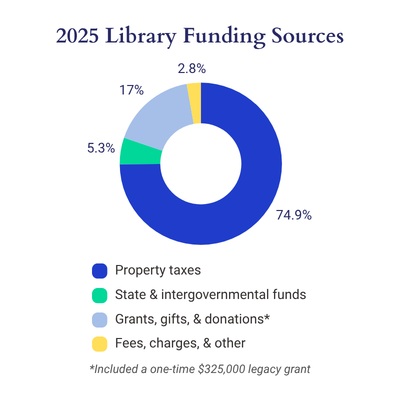
Source: 2025 Annual Financial Report
How property tax funding works
A few things help explain how the Library's property tax funding actually works:
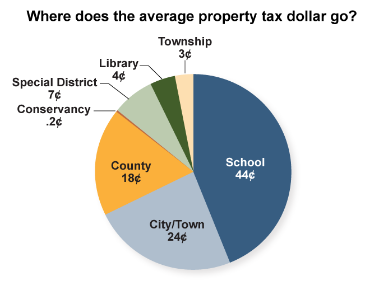
The Library's levy is the portion allocated to spend on Library services. Currently, for every dollar you pay in property taxes, four cents goes to the Library. (Graphic Source Indiana Gateway). For a more detailed look at property taxes in Indiana see the Department of Local Government Finance: Citizens Guide to Property Tax.
The Library requests a budget, not a tax bill. Each year the Board of Trustees adopts a budget and requests a property tax levy (the total it needs to operate), reviewed through a public process and certified by the State of Indiana. The Library can't simply collect more, the state limits how much the levy can grow each year.
The rate comes from the levy. The rate is the levy spread across all taxable property in the district. In 2025, a $1,669,669 levy across about $1.62 billion in net assessed value produced a rate of $0.1030 per $100 of assessed value.
Assessed value isn't market value. Property is taxed on its value after deductions, such as the homestead deduction, so a home's taxable value is usually well below its market price.
Tax caps limit what anyone pays. Indiana's constitutional caps limit a total tax bill to 1% of a home's value (2% for other residential and farmland, 3% for commercial). When a bill hits the cap, the Library and other local units collect less than they levied.
How the money is used
The Library’s funding supports everything the community relies on:
Staff - In 2025, the Library employed about 30 people who serve patrons, run programs, manage the collection, and keep both branches open.
The collection - Books, audiobooks, eBooks, movies, music, research databases, and digital resources for every age.
Programs and services - Free programs for children, teens, and adults; public computers and Wi-Fi; meeting spaces; and outreach across the county.
Operations - Utilities, maintenance, technology, and the everyday cost of keeping the buildings open and welcoming.
The Library’s complete budget is a matter of public record, posted on the Indiana Gateway transparency portal.
Guided by community priorities
How the Library invests its funding is shaped by our Strategic Plan, adopted by the Board of Trustees and developed with extensive community input. This included a survey of more than 500 residents, interviews with community leaders, and community conversations. The plan sets the Library’s direction around welcoming spaces, access, and expanding its reach in the county.
Funding FAQ
-
Anyone who owns taxable property within the library district contributes: homeowners, owners of rental and commercial property, businesses, and farmland owners. Renters contribute indirectly, since property taxes are part of what owners factor into rent. Some property, such as government, church, and nonprofit-owned property, is tax-exempt.
-
If a need arises that goes beyond the year's adopted budget, the Library can request an additional appropriation, a public process that must be advertised and approved by the Jefferson County Council before any money is spent. The Library also sets aside money in reserve funds to plan ahead for larger or future costs, rather than depending on a single year's budget.
-
The levy is the total dollar amount the Library collects in property taxes. In 2025, that was $1,669,669. The rate is the amount charged per $100 of a property's net assessed value. It's found by dividing the levy across all the taxable property in the district (which totaled about $1.62 billion in 2025). The Library's 2025 property tax rate was $0.1030 per $100 of net assessed value.
-
The Library maintains its buildings through its operating budget, uses reserve funds for larger needs, pursues outside grants and community partnerships, and publishes its complete budget on the state's public Gateway portal for anyone to review. Through appropriate management, the Library offers a return on investment of $2.50 for each $1.00 of property tax revenue received.
-
The Library maintains reserve funds, including a Rainy Day Fund, to handle unexpected or emergency costs without disrupting day-to-day service. For example, the Library recently used Rainy Day funds to upgrade its elevator.
-
Day-to-day operating funds (from property taxes) can't be used for large construction, and vice versa; they're kept separate by law. Major projects like renovations are typically financed through a bond, which spreads a large, one-time cost over time.
-
The Library is one of several local units (alongside the county, city, township, and schools) that share your property tax bill, and it is a small portion of the total. For the exact amount on your own property, see your tax statement or the county's records.
-
The Library's complete financial information is public and available on the Indiana Gateway dashboard.